Cost Analytics @ GEP
Redesigning the user experience for a cost analytics platform to increase usability, adoption and tight integration among sourcing teams.
Overview
Tools should never hinder ability. Ensuring stakeholders have the right tools for cost management is crucial for unlocking maximum business value.
Problem
Category Managers & Cost Engineers have a variety of tools at their disposal to estimate costs of sourcing resources. But the learning curve on these tools is high, increasing time required by new users with solid fundamentals to create impact.
Solution
Given the freedom to experiment with designs not limited by legacy standards, we introduced design features and redefined flows typically found in consumer-facing applications to reduce the learning curve and increase time spent creating business value.
Business Impact
Final Application Design
Support cost decisions effectively.
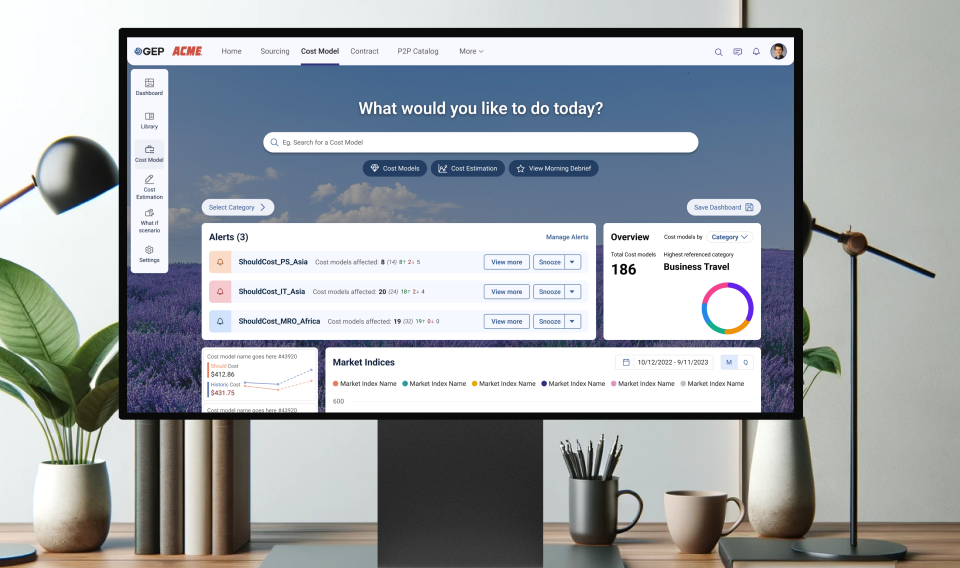
Cost Analytics provides a suite of tools that equips stakeholders to identify trends, stay up to date with markets and plan for a variety of scenarios, facilitating organisations to make bold and calculated decisions.
- Identify market trends - Source resources cost effectively with the highlighted market trends and maximise margins.
- Stay up to date with Alerts - Setup alerts to stay up to date and get notified of fluctuations in market indices.
- Plan for adversity - Prepare for unforeseen scenarios by exploring and visualising variations in cost models with What-if modelling.
- Monitor with an AI-powered dashboard - Monitor everything important, and receive an AI powered overview of the most consequential fluctuations.
Domain Research
What is Sourcing?
Sourcing is the process used to identify, evaluate, and acquire items required by organisations to conduct operations. When an organisation decides to manufacture a new product, they start by understanding the cost opportunities involved. They request tenders from suppliers of the materials, which enables them to figure out who can supply which materials at the best costs.
Where does Cost Analytics fit in?
After suppliers submit bids, organisations need to negotiate with them for a good deal. By leveraging market indices and price libraries, and simulating all potential cost drivers, organisations are able to determine what a product should cost, enabling competitive, well-informed negotiations.
Understanding the Stakeholders
Users for the application were not readily accessible for primary formative research, so we analysed business requirements from clients and had multiple in-depth discussions with members of the product team who had worked closely with users.
Category Managers
Source materials for their organisation from suppliers at the best possible price. They monitor category savings, identify cost opportunities, and take decisions on overall purchase strategies.
"When I receive quotes from suppliers, I want to compare the costs with the cost benchmark my cost engineer has created. This allows me to ensure that the costs are negotiated at a fair value."
"When markets fluctuate, I need to know which categories are impacted, and I want to understand the trend of the impact so that I can plan my sourcing activities."
Cost Engineers
Subject matter experts on costs. They digitise the breakdown of costs to be used by category managers when sourcing items, and model alternative scenarios to support decision-making.
"I want to be able to further anticipate potential changes in market conditions and visualise the impact on my expected costs, staying prepared in case of any unexpected developments."
"I want to be able to modify cost structures as and when manufacturing processes change, so that stakeholders are always up to date with the should costs of products."
Problem Statement
"How can we enable Cost Engineers to effectively support various Category Managers in their decision making processes?"
A more integrated approach enabling comprehensive preparation for negotiations.
A robust, omni-present market trends notification system for proactive decisions.
More versatile tools to seek out and plan for unforeseen contingencies.
A solution to monitor cost-sensitive factors and keep internal stakeholders aligned.
Repeatable Design Process
Once we realised the various features were independent of each other, much like different tools for different tasks, a repeatable process emerged that we used across all five product features.
- Understand user goals through Jobs to be Done
- Identify why the current product makes it challenging to achieve those goals
- Refer to competitors and analogous solutions to mitigate the challenges
- Verify the validity and usability of the design with domain experts
Conclusion & Learnings
Being in a new field, I learnt to look at ambiguity as an opportunity to differentiate my designs from competitors.
It saves a lot of time and effort to verify assumptions before designing a solution.
Being comfortable not knowing everything about your user, and revisiting features based on updated understanding, is critical.
Creating simple designs is essential. But knowing when adding complexity helps functionality is equally important.
Understanding the context within which a product is used is key to designing novel, yet familiar experiences.
Finding the one singular factor that defines the problem is of utmost importance, and tackling this elevates the experience.